Woodard & Curran led both the technical development of the plan and the associated outreach in partnership with Stockton East Water District and Calaveras County Water District, bringing together regional climate science, local hydrologic modeling, and extensive stakeholder engagement into a single, coordinated planning framework. The result is a technically defensible, community-informed plan designed for implementation.
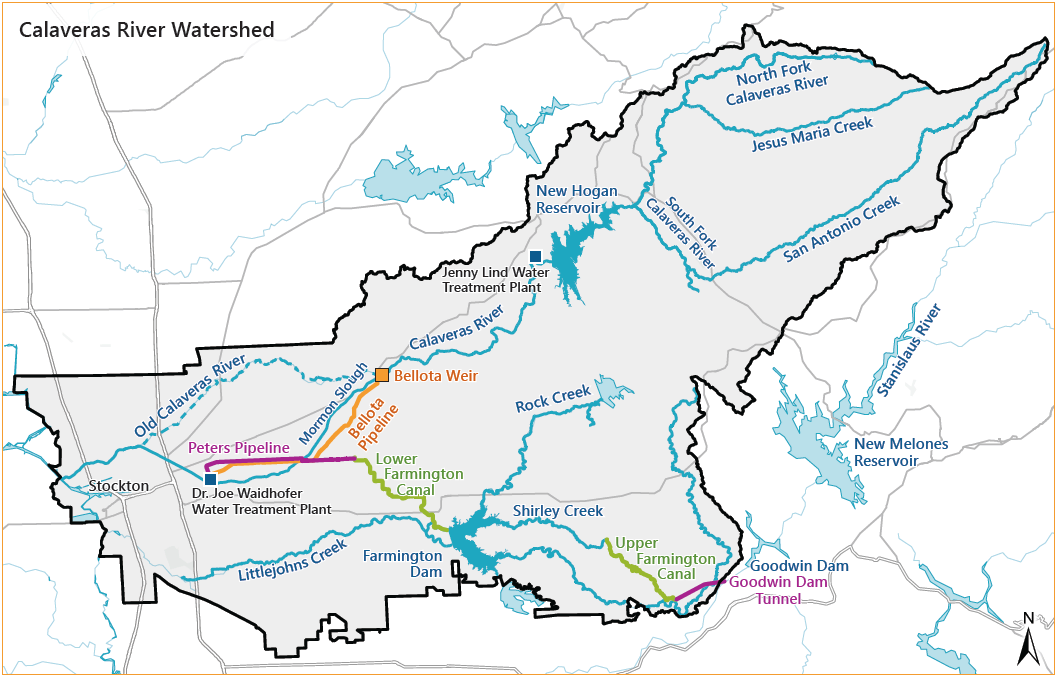
Graphic created by Cindy Potter Graphic Design
A Multi-Scale Modeling Approach
The technical foundation of the plan centers on the Calaveras Watershed Resilience Plan Model, which integrates tools and datasets from DWR’s San Joaquin Watershed Studies with the locally developed Eastern San Joaquin Water Resources Model (ESJWRM), calibrated to watershed-specific conditions. Rather than relying on a single climate projection, the project team evaluated sixteen distinct climate scenarios spanning a range of temperature and precipitation futures, providing water managers with a comprehensive picture of how the watershed may respond under conditions ranging from moderate warming to more extreme climate futures.
The modeling framework assessed vulnerability across six interconnected risk categories: flood, water supply, groundwater basin conditions, wildfire, surface water quality, and the economy. Under the most probable climate scenario, the team found a 13 percent decline in surface water deliveries and an 8 percent increase in groundwater pumping demand, underscoring the urgency of proactive investment. Importantly, our analysis confirmed that coordinated adaptation strategies can offset these impacts based on modeled strategies capable of restoring groundwater basin conditions to near-current levels despite a 2°C warming scenario.
Community-centered planning
What distinguishes this plan is not just its technical rigor, but how it was built. The Calaveras Watershed Network brought together water agencies, local governments, agricultural producers, tribal representatives, and community members throughout the planning process. We facilitated a sustained, inclusive engagement program that spanned public meetings, targeted conversations, workshops, and an online platform to ensure that the adaptation strategies reflect real operational priorities and community values. We intentionally designed the public outreach program to reduce barriers to participation, including making highly technical materials accessible to the general public. Through this engagement process, we were able incorporate local knowledge directly into our technical analysis.
With the plan developed, we are currently developing a summary booklet and interactive website to help community members visualize potential project results and implications.
Strategies built for action
The project team organized the plan’s adaptation strategies into implementation tiers, allowing near-term actions to advance with existing infrastructure while longer-term investments are planned and funded. The team recommended priority water management strategies that focus on managed aquifer recharge, expanded surface water deliveries, and forecast-informed reservoir operations (FIRO). The proposed Farmington Reservoir Project anchors the long-term strategy, and could provide up to 60,000 acre-feet of additional surface storage capacity that benefits 315,000 City of Stockton residents and 140,000 acres of agricultural land.
The plan also included wildfire risk reduction and land management strategies to address threats to upper watershed water quality and community safety. By implementing these strategies in the top 10 identified priority zones, there is an 18 percent reduction in burn probabilities and an 88 percent reduction in flame lengths. This indicates that, if wildfire mitigation strategies are implemented , both the likelihood of a wildfire occurring and the intensity of any fire that may occur is significantly lower.
Through delivery of the final Calaveras River Watershed Resilience Plan, Woodard & Curran was able to demonstrate that with the right combination of modeling innovation, stakeholder collaboration, and actionable strategy development, California watersheds can move from vulnerability assessment to implementation-ready plans. This effort provides valuable information to DWR as it looks to expand the Watershed Resilience Program statewide. Woodard & Curran is proud to support this work and looks forward to advancing similar integrated approaches in other watersheds across the state.
