Since then, Woodard & Curran has supported 14 comprehensive vulnerability assessments in partnership with inland Florida municipalities. These assessments are designed to identify and address risks to critical infrastructure from severe weather and flooding impacts. Our experts leverage hydraulic modeling technology to first evaluate critical infrastructure’s exposure and sensitivity to statutory flood scenarios, which informs prioritized recommendations to adapt and enhance resilience.
These vulnerability assessments leverage community engagement, targeted data analysis, and advanced hydraulic modeling to develop reports that provide municipalities with a clear, actionable plan to reduce flood risk and improve resilience for drinking water and wastewater facilities and infrastructure, transportation and evacuation routes, community and emergency facilities, and natural, historic and cultural resources. We provide efficient, high-impact vulnerability assessments tailored to each client following these key steps:
- Identify data criteria and standards required to create a vulnerability assessment.
- Develop a project management plan including scope, goals, schedule, milestones, and deliverables to be rolled out during the project kick-off meeting.
- Identify and gather data on assets and systems to be evaluated to develop an asset inventory and clarify hazards, such as increased rain intensity and duration, pluvial flooding, sea level rise, storm surge, and high tide flooding.
- Conduct exposure and sensitivity analyses to assess flood-related risks to critical assets, which will determine the depth of water associated with each hazard scenario and assign a risk score for each asset and system.
- Compile findings in a clear, actionable report that includes maps, tables, and prioritized recommendations with the exposure and sensitivity analysis results and a summary of risks.
- Deliver recommendations to reduce vulnerabilities and risks, such as infrastructure upgrades, operational changes, emergency response planning, and policy updates.
Throughout the process, Woodard & Curran collaborates with our client and the community to ensure the data gathered, risks assessed, and recommendations made match existing concerns based on local knowledge and capture desired outcomes. Not only does this provide a foundation for the municipality to make informed decisions to enhance resilience, but it also positions the community for critical state and federal funding to implement priority projects. In addition to our support of the vulnerability assessments and resulting engineering design for recommended projects, Woodard & Curran’s fiscal solutions team has partnered with 11 of our Florida clients to help secure nearly $1.7 million in grants for the assessment work. The team further helped four communities apply for and secure $40.5 million in Resilient Florida Implementation Grants for project implementation.
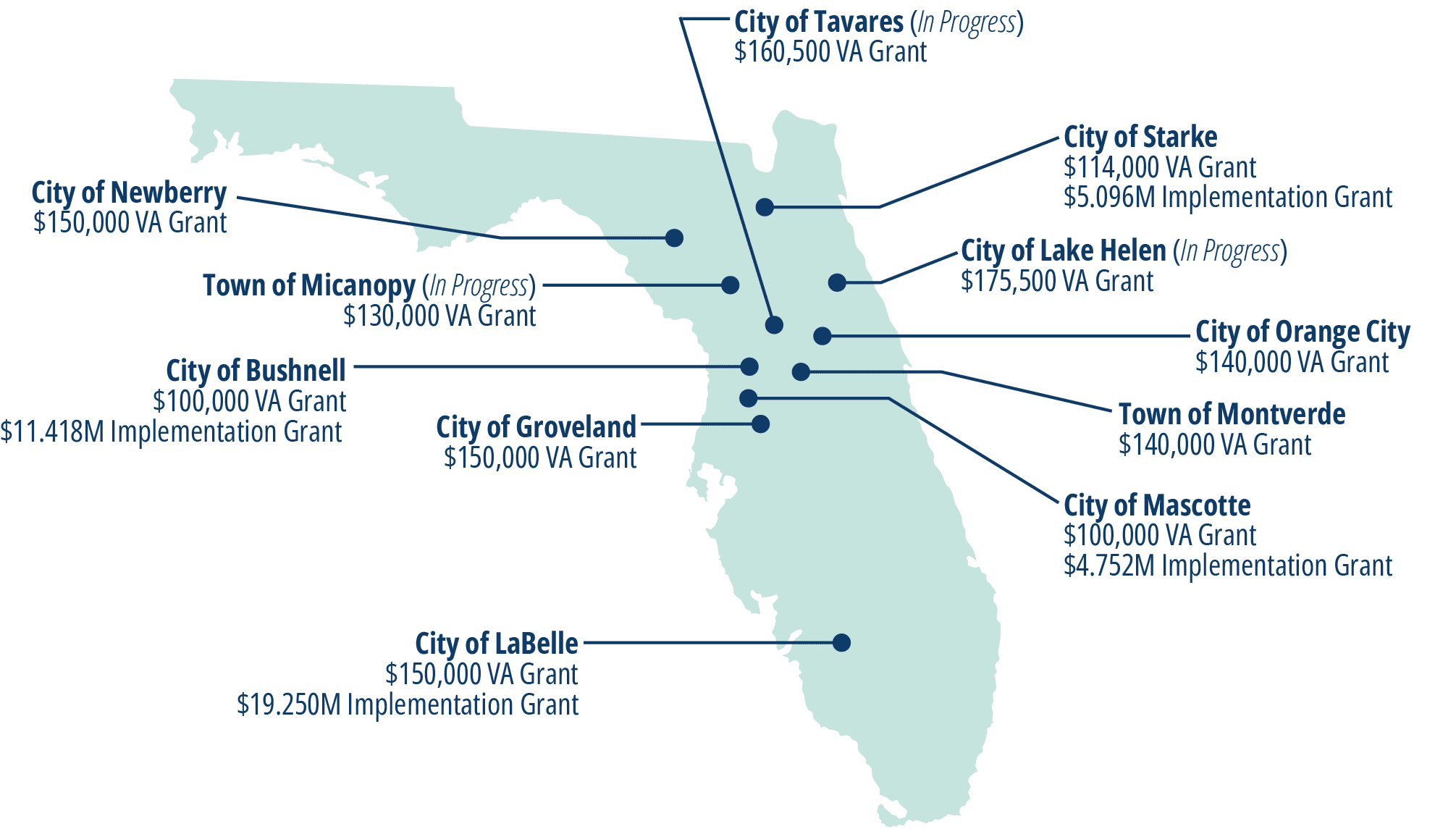
Breakdown of Grant Funding by Municipality
Putting Implementation Grants to Use
The vulnerability assessment for the city of Bushnell identified its wastewater treatment facility (WWTF), master lift station, and several neighborhood lift stations as high priority assets. While risk for these assets was deemed minimal based on modeling, a single storm in August 2021 brought seven inches of rainfall in a 12-hour period that overwhelmed the collection system, triggered high wet well alarms at the master lift station, and caused catastrophic failure of Sequencing Batch Reactor Tank #4. The resulting wastewater discharged required nearly $2 million in emergency response, engineering services, cleanup, and reconstruction. With the basis of the city’s vulnerability report, they applied for and received a $11.418 million implementation grant to improve, expand, and upgrade its WWTF and associated structures with modern, hardened treatment technology, elevated structures, and storm-resilient electrical and mechanical systems.
The WWTF in the city of LaBelle was also identified at high risk of flooding with the potential for operational failure or permanent damage as a result. Located along a rural, tree-lined dirt road at an elevation of 12.09 feet, the city has already experienced issues accessing the WWTF during heavy rainfall or tropical storms and hurricane events. LaBelle requested and received $19.25 million to fund the relocation and construction of a new, flood-resilient WWTF designed to withstand future precipitation and flooding conditions. The new facility will incorporate advanced resiliency measures, such as permanent backup generators, submersible pumps, concrete tanks, and hardened facility components, floodproofing of structures, waterproofing of electrical systems and circuitry, and deployment of a modern Supervisory Control and Data Acquisition (SCADA) system for remote monitoring, control, and operation to enhance response during emergencies.
Similarly, the city of Starke identified critical wastewater infrastructure at significant risk of inundation along the Alligator Creek basin and within the downtown corridor, where storm-induced flooding and stormwater runoff have repeatedly threatened the reliability of the city’s wastewater collection system. To address these issues, Starke applied for and received $5.096 million for pre-construction and construction of system improvements to several wastewater lift stations that will protect essential public services, reduce environmental and public health risks, and ensure long-term system resiliency. The scope of the project includes adaptation measures such as elevating electrical and mechanical components, installing floodproofing systems, relocating facilities away from high flood-risk zones, improving access to facilities, and providing reliable backup power.
State Route 50 was identified as a high-risk zone for the city of Mascotte, which includes the water treatment plant (WTP) and on-site public works facility. Due to its proximity to low lying terrain near Lake Jackson and Sunset Lake, flood modeling showed depths of 0.02 feet (14 percent parcel inundation) under current 100-year storm conditions and up to 1.9 feet (33 percent parcel inundation) under future 500-year scenarios. These types of scenarios would disrupt essential public works operations during a storm, as such, the city has proposed relocating the public works facility outside of flood-prone areas. They applied for and received a $4.752 million implementation grant for pre-construction activities including site planning, engineering, and permitting. Relocating this facility will ensure the Public Works Department is able to deliver vital services that protect public health and safety during weather emergencies.
