Service line inventory development and regulatory reporting
SFPUC was required to develop inventories of all the utility- and customer-owned water service lines to identify the pipeline materials. SFPUC had already completed the service line inventory for the San Francisco Water System; however, SFPUC solicited Woodard & Curran’s expertise to prepare service line inventories for other water systems under its control. This work directly supported reporting compliance efforts to California’s Water Resources Control Board Division of Drinking Water (DDW).
The scope of this project included preparing water service line inventories for the Town of Sunol and the Regional Water System, each serving connections in unincorporated areas of Alameda, Santa Clara, and San Mateo counties. Woodard & Curran’s experts collaborated with the client’s project coordinator and staff to review and organize existing data in the format required by the DDW. The team also verified anomalies or gaps in field inspection data and other public records to deliver comprehensive inventories.
Regulatory-required public communications
A significant part of the federal LCRI regulation is notification, education, and outreach to the public, ensuring water consumers are informed of the dangers of lead in drinking water. SFPUC is required to deliver timely, transparent communications regarding LCRI activities.
Our public communications experts assisted with the preparation of the required annual service line inventory notifications by identifying ideal timing, format, content, and channels for delivering information to the public, along with a template that conveys mandatory information clearly. The team supported SFPUC in sending notices to more than 1,000 customers about their service line material if it was galvanized requiring replacement (GRR) or unknown. The required language was very specific and, for a layperson, difficult to understand. While utilities are not able to change the required language, we worked with SFPUC to add more information, including an introduction, summary, and easier to understand explanations. Where applicable, we incorporated graphics to augment the explanations. Our team also supported the restructuring of SFPUC webpages with revisions to key information to align with other communications, including providing access to an interactive map of service lines that the community can use to confirm their service line material.
Woodard & Curran also developed a Strategic Communications Plan that established a proactive framework to inform, engage, and involve the community in SFPUC’s LCRI compliance efforts, fostering transparency, trust, and inclusive collaboration. This plan is a part of an overall LCRI Compliance Plan that Woodard & Curran developed for SFPUC to serve as a comprehensive roadmap for compliance activities.
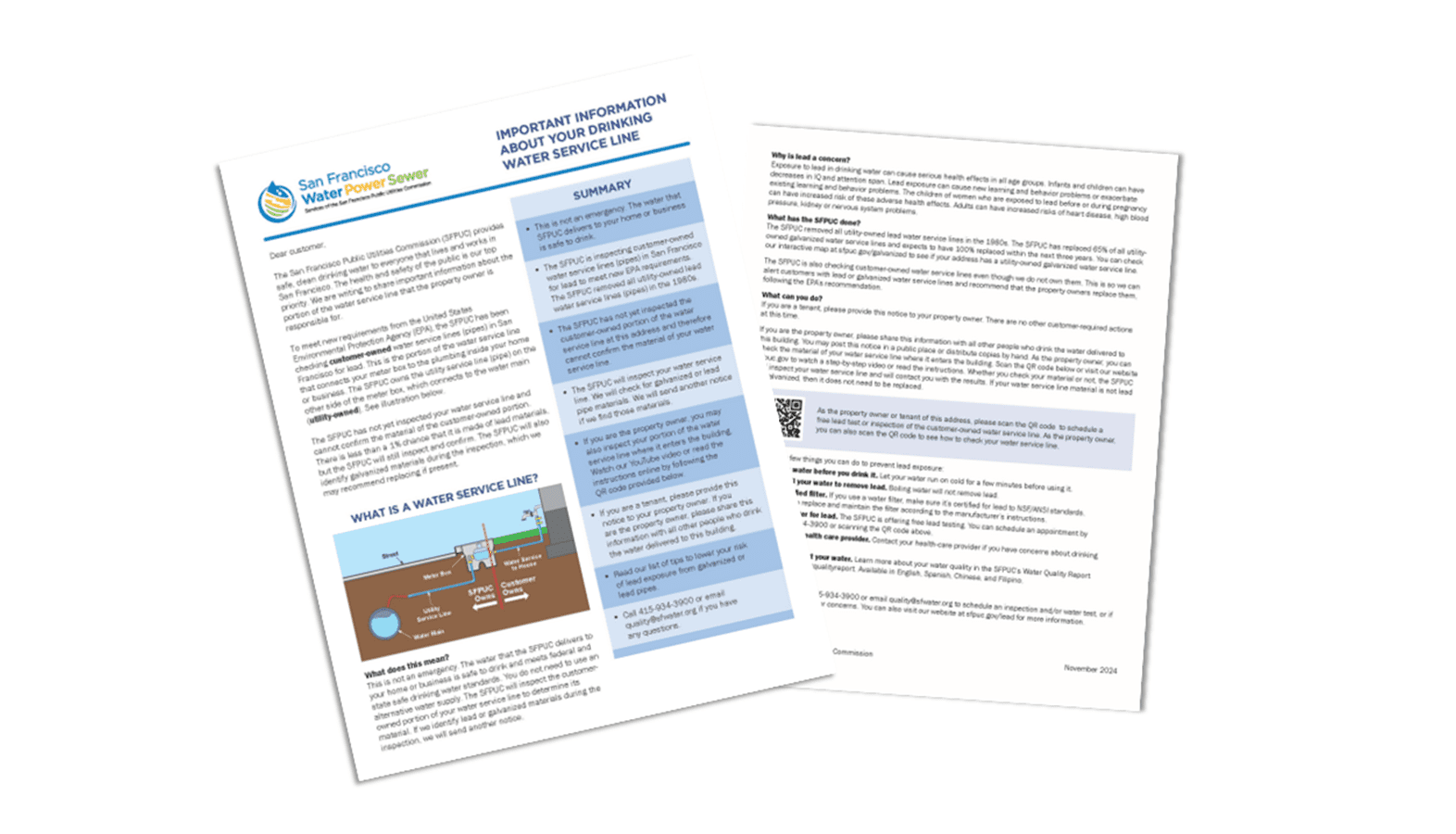
Example of SFPUC’s Public Noticing
A comprehensive roadmap to regulatory compliance
Following completion of SFPUC’s initial service line inventory and associated public noticing, the project team developed a comprehensive LCRI Compliance Plan to outline activities necessary to meet the federal regulation and to translate complex regulatory requirements into actionable strategies tailored to SFPUC’s unique infrastructure and community needs. The plan presents a clear roadmap for achieving compliance across key program areas, including service line inventory updates and non-lead validations, tap monitoring, school and childcare facility sampling, unknown service line investigations, and service line replacement strategies. For each of these key program areas, the plan outlines key aspects of the regulation, defines milestone dates, and discusses SFPUC’s completed and planned implementation activities. It also provides guidance on staffing, funding mechanisms, and public education and outreach measures to enable SFPUC to meet deadlines while maintaining transparency and community trust. Our work supports SFPUC’s proactive approach to lead risk reduction by including early pilot sampling for schools and childcare facilities, accelerated unknown inspections, and strategic communications planning. Our work also reflects SFPUC’s commitment to innovation, by investigating eight emerging and minimally invasive technologies that could help to identify unknown service line materials in locations where traditional methods are impractical or disruptive.
