In-situ remedies can fail to meet performance goals for reasons that are often visible before a design is finalized or remedy implemented: incomplete source-area characterization, misunderstood hydrogeology, uncertain degradation rates, or poorly constrained amendment dosing. A fit-for-purpose pre-design investigation (PDI) helps refine the conceptual site model (CSM) and close those gaps before they become costly remedy-performance problems.
Common in-situ remedies include in-situ bioremediation (ISB), in-situ chemical oxidation (ISCO), and in-situ chemical reduction (ISCR), which can be implemented as source area treatments or permeable reactive treatment zone configurations. Common treatment objectives include source area contaminant mass reduction and achieving numerical cleanup criteria at a point of compliance.
One of the most frequent reasons that an in-situ remedy fails to meet project objectives is a poorly conceived CSM. A poorly conceived CSM, in turn, influences treatment design and may result in untreated source areas, inappropriate remedy selection, and/or an ineffective performance monitoring network. Conversely, an in-situ remedy can be overdesigned to compensate for a lack of key remedy design information and an inadequate CSM. Ultimately, not having an effective and robust CSM can lead to poor remedy performance and wasted resources.
Using pre-design investigation to address data gaps and improve remedy performance
A properly designed pre-design investigation can inform a planned remedy during design or transform a failing remedy to a successful solution. An effective PDI allows practitioners to focus on remedy objectives and refine the CSM to produce a better remedial design. A variety of diagnostic tools are available to overcome the challenges of inadequate CSMs. Several categories of CSM shortcomings and corresponding diagnostic tools that may improve CSMs are discussed below.
Characterization of contaminant source areas
High-resolution site characterization (HRSC) using hydraulic direct-push drilling coupled with sensor-based technologies, such as membrane-interface probe (MIP) and cone-penetrometer testing (CPT), generates continuous records of volatile organic compound (VOC) concentrations and soil characteristics such as lithology and hydraulic permeability. The MIP includes photoionization detector (PID), flame ionization detector (FID), halogen specific detector (XSD), and electrical conductivity (EC) sensors, which enable qualitative to semiquantitative detection and characterization of VOC concentrations and vertical distribution.
Tools such as the Optical Image Profiler (OIP), UVOST, TarGOST, and dye-enhanced laser induced fluorescence (DyeLIF) may be applied to detect and characterize hydrocarbon fuels and oils, lubricants, coal tar, chlorinated solvents, and the presence or absence of nonaqueous phase liquids (NAPL).
The data generated from these sensors can be correlated with physical contaminant concentrations and soil characteristics collected from traditional soil and groundwater investigation techniques, such as soil borings and monitoring wells, to support quantitative analysis of the sensor data. Important remediation design metrics such as soil NAPL saturation and concentration relative to percent of solubility in groundwater, vertical distribution of contaminated intervals, and hydraulic conductivity can be estimated or calculated from these data. In summary, HRSC allows for detailed refinement of the three-dimensional distribution of contaminants and physical aquifer characteristics in source areas.
Site hydrogeology
Identification and determining the distribution of relatively high permeability (coarse sands and gravel) and low permeability (silts and clays) soil matrices is critical in the design of in-situ remedies. Relatively higher zones of contaminant mass flux, which affect plume expansion and contaminant migration rates, generally occur in hydraulically conductive zones; thus, emplacing higher doses of reagents in those conductive zones can increase longevity of in-situ remediation reaction chemistry and provide more effective plume remediation. Low permeability zones can serve as long-term contaminant reservoirs that may support plume longevity. Relatively low permeability intervals, such as silt- and clay-rich intervals containing residual source mass, can be identified and targeted for in-situ remediation injections separately from more conductive zones.
The hydraulic profiling tool (HPT), often coupled with the MIP as part of HRSC investigations, provides continuous vertical characterization of hydraulic permeability to support identification of higher and lower conductivity zones. Down-well passive flux meters may be applied to quantify the groundwater Darcy velocity and contaminant flux versus depth in the screened intervals of monitoring wells. Overall, the use of a combined suite of tools allows for a robust understanding of the vertical distribution of groundwater and contaminant mass flux, enabling the development of targeted remedies.
Enhanced data analysis and visualization
Modeling software may be applied for advanced data analysis and to integrate and graphically visualize HRSC data with other hydrogeologic, contaminant, geochemical, and water quality data. These software tools allow rapid and flexible visual and quantitative analysis of plume architecture. Contaminant distributions and other characteristics can be viewed in any perspective, rotated in three dimensions, and sliced to visualize data in in from different views, such as planar, cross-sectional, and oblique perspectives.
Such visualization provides valuable information to inform remedial design. For example, a low permeability zone of saturated soil with residual NAPL may be quantitatively identified with this type of analysis and targeted for focused treatment to mitigate the source of a dissolved phase VOC plume.
Biogeochemistry and degradation rates
In addition to the contaminant type and distribution, in-situ remedy selection and design should consider biogeochemical conditions. For example, ISCR and anaerobic bioremediation technologies generally align better with geochemically reducing conditions (negative oxidation-reduction potential, near zero dissolved oxygen), while ISCO and aerobic bioremediation generally fit better with oxidizing biogeochemical conditions. Contaminant degradation rates correlate to subsurface reaction times and thus influence size and location of treatment zones.
Ambient biotic and abiotic degradation rates may be assessed using field data. Laboratory bench and field-pilot testing may be used to further quantify enhanced degradation rates and evaluate different types of amendments. Overall, improved understanding of site biogeochemical conditions and contaminant degradation rates allows more informed selection and design of in-situ remedies, including selection of appropriate reagents, sizing of the remedy, and assessing anticipated cleanup timeframes.
Amendment dosing
The chemistry and contaminant degradation reactions associated with using amendments such as chemical oxidants, oxygen sources, carbon substrates, and zero valent iron are well understood. However, the proper dosing of these reagents is dependent on a variety of site-specific factors, including:
- Groundwater Darcy velocity;
- Concentrations of terminal electron acceptors such as DO, sulfate, nitrate, and iron;
- Soil and groundwater oxidant demand; and,
- pH buffering capacity.
Groundwater velocity affects not only the dissolution of emplaced amendments, but the rate of reactivity of the amendments with other groundwater constituents. Moreover, carbon substrate dosing needs to account for the concentrations of terminal electron acceptors. Further, oxidant dose is generally driven by soil oxidant demand rather than contaminant concentrations. The ability of the aquifer to buffer against changes in pH and sustain circum-neutral pH is important for in situ bioremediation and chemical reduction reactions. Quantifying these factors allows for better estimates of amendment doses for the desired longevity of the in-situ remediation technology that is being applied.
Pre-design investigation return on investment
The need and scope of a pre-design investigation should be evaluated in the context of return on investment (ROI), for example the resulting influence on remediation cost and the cost of not meeting remedial objectives. The figure below presents a conceptual ROI relationship between remediation cost and risk of not meeting objectives versus PDI extent and cost.
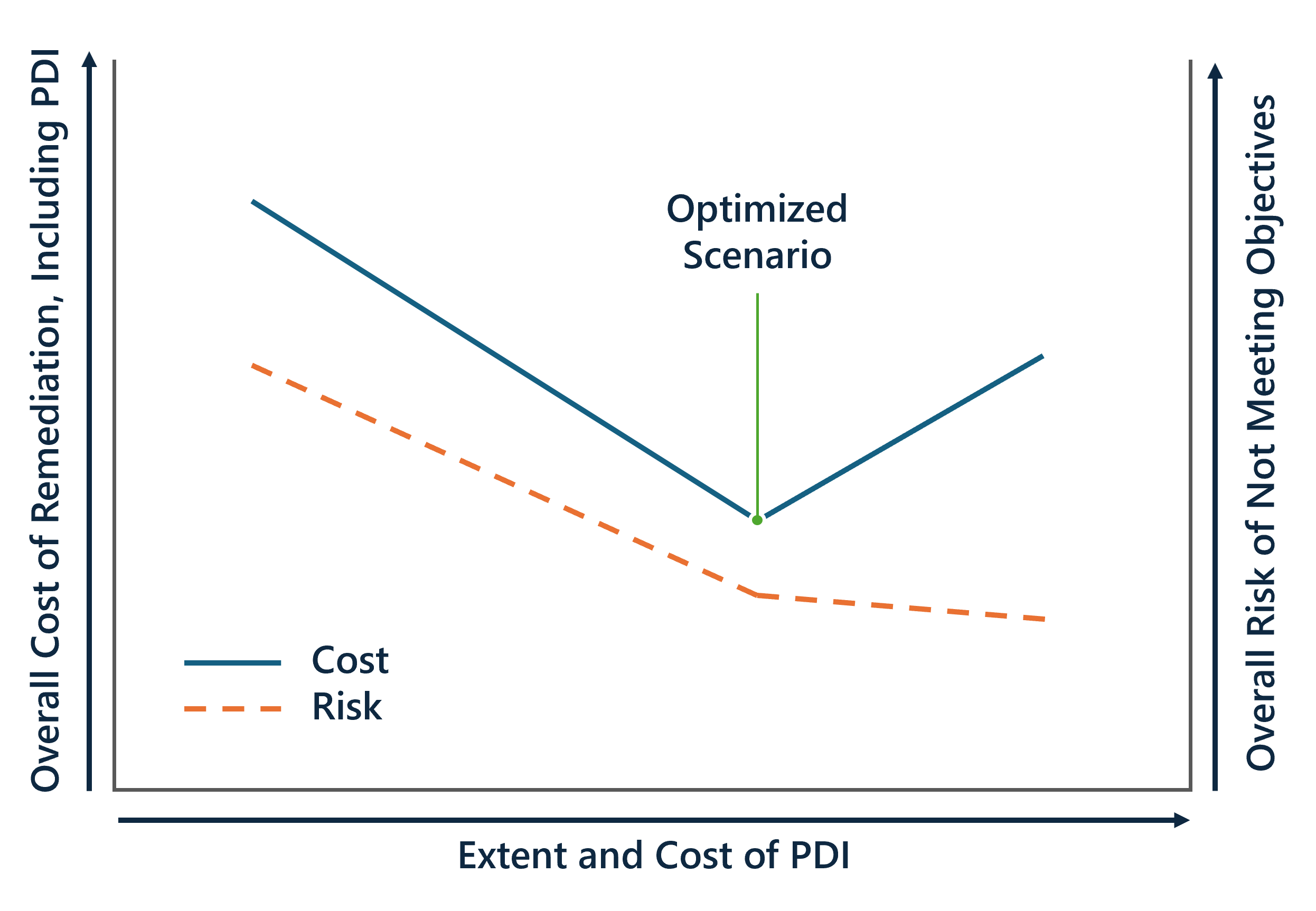
Performing additional PDI activities decreases remediation costs, by refining the CSM to improve the remedy design. However, at some point (i.e., optimized scenario), additional PDI activities do not lead to further remediation cost reductions but rather start to increase the overall cost of the remediation. Conversely, performing PDI activities continues to decrease the overall risk of the remediation not meeting objectives. However, the rate of risk reduction becomes much slower with increased PDI actions, reducing the ROI of the additional PDI activities.
Key takeaway
In summary, a focused PDI featuring modern characterization and analysis techniques can refine CSMs, which results in stronger in-situ remediation designs and improved outcomes, and reduces project uncertainty and cost. There are a wide variety of PDI tools that can be applied based on the needs of a particular project. However, an overall PDI program can be fine-tuned by examining the ROI of performing PDI activities in the context of managing risk of performance and cost of the remedy.
