There is no question that Artificial Intelligence (AI) is evolving how we all do business these days. Some job functions can lend themselves to relying heavily on Microsoft CoPilot, but can AI enhance how operators are running utilities? While it may seem challenging, the answer is yes.
Since the founding of Woodard & Curran, we have always kept up with the latest industry technology to ensure we deliver the best service to our clients. In operations, this included developing an application that automates processes and supports our staff in making complex operational decisions. During the Florida Water Resources Conference in April, my colleagues Steve Schwab, Operations Chief, Eddie Piechowicz, Project Scientist, and I presented on how we are using cutting-edge machine learning models to forecast groundwater elevations and provide real-time visual alerts in a one-of-a-kind dashboard for one of the nearly 100 facilities we operate across the country.
Monitoring Groundwater Elevations with Machine Learning
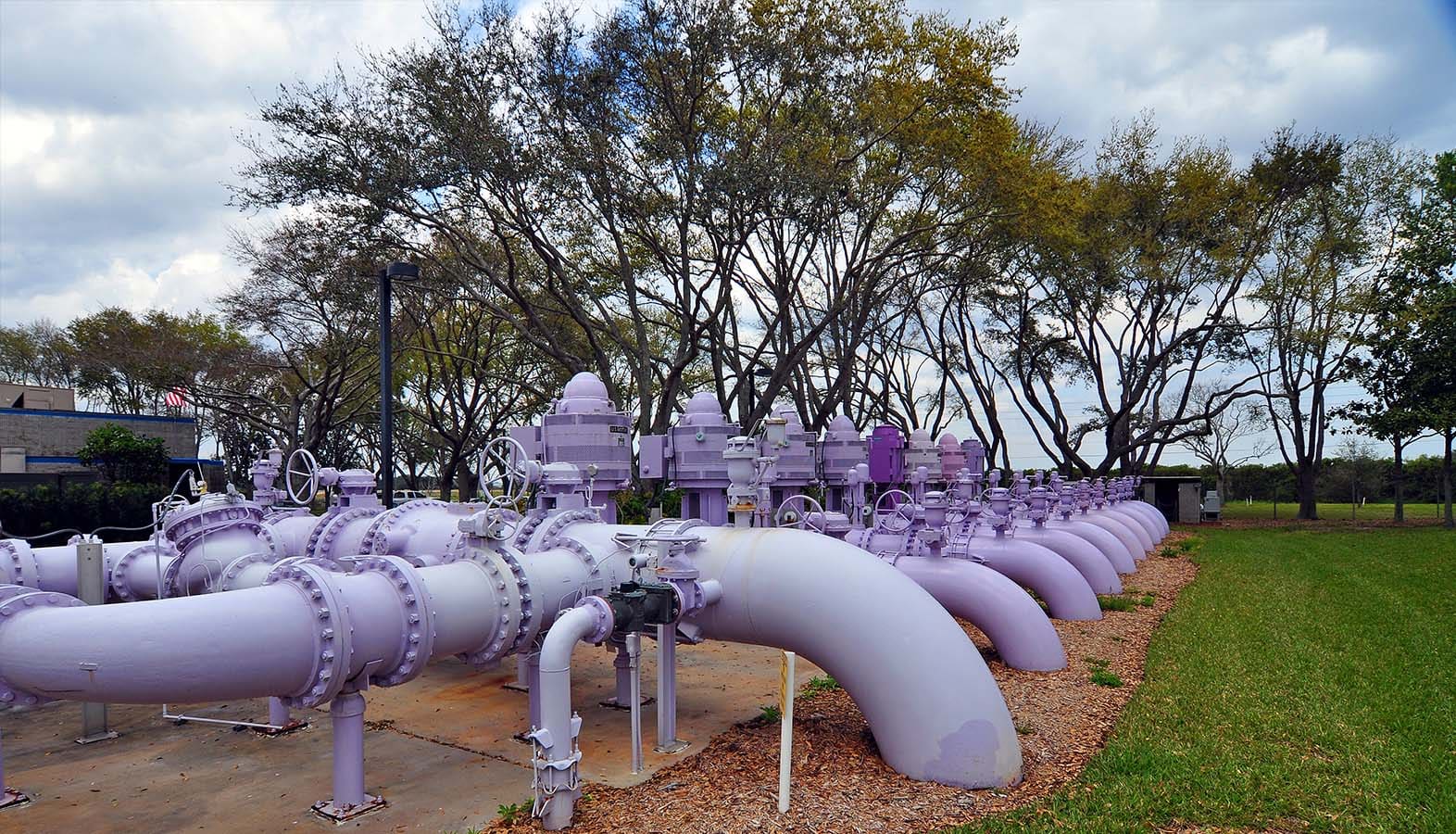
Water Conserv II, serving Orange County and Orlando, Florida is the world’s largest water reuse project of its kind, providing large-scale agricultural irrigation and aquifer recharge via rapid infiltration basins (RIBs). Operations of the 60 RIBs processing peak flows of up to 90 million gallons of water per day rely on a small team of operators who regularly make complex decisions about which RIBs to activate while monitoring weather conditions and groundwater elevations. Processes involved with the decision making currently rely heavily on an individual operator’s institutional knowledge, which puts daily operations at risk. We saw this challenge as an opportunity to augment operations with the help of AI.
In collaboration with the operations team, we worked to understand procedures and identify pain points to develop a solution to enhance, not replace, human expertise. The tool, which forecasts groundwater elevations to alert operators as they approach ground surface level, was developed using a cutting-edge machine learning framework that integrates weather data, hydrogeologic conditions, and operational parameters with fully automated advanced modeling pipelines and unique machine learning models for each monitoring well. The data is processed by removing seasonal patterns and adjusting based on trends to improve predictions. The models are then fine-tuned and validated by evaluating performance across different time periods to ensure reliable results. This approach delivers exceptional predictive performance.
Continuous data collected since 2007 was used to train the models for wells that are integrated into a web-based dashboard. This creates a one-of-a-kind, real-time AI decision support system with visual alerts and actionable recommendations based on the planned RIB flows entered weekly by staff. The dashboard includes color-coded wells and compliance indicators to provide immediate understanding of system status across the facility while predicting intervals enable confident risk assessment and proactive decision making. Visual alerts help prevent potential violations while optimizing system capacity during varied weather conditions and demand scenarios.
New horizons for operational efficiency
Before implementing this tool, an operator had to review all piezometers by RIB site, examine trends over recent weeks, review history of flows in worksheet format, then map out the current week’s RIB flows based on knowledge of topology, piezometer trends, historical RIB flows, and expected weather. For junior staff, this process takes a long time. Leveraging the tool, operators enter planned flows into the dashboard and run predictions. The dashboard displays piezometers color-coded based on its proximity to ground surface and flags areas for review. It provides a starting point for new operators that don’t have decades of site-specific intuition, increasing their confidence in operational choices and freeing up time to focus on other activities.
The risk of losing institutional knowledge as operators retire is not unique to Water Conserv II. We see this issue affecting utilities nationwide. Machine learning and AI present an opportunity to capture institutional knowledge and combine it with historical data that is likely already documented. What we developed at Water Conserv II is easily transferrable to other facilities where consistent monitoring data and well-defined operational decision making is available. With the success of this pilot effort to integrate AI into operations, we hope to see more use cases identified at the current and future facilities we operate.
