About four years ago, I began noticing a shift in how we approach long term water supply planning. After two decades of developing integrated water resources plans, it became clear that traditional, static portfolio-based planning frameworks were no longer sufficient for the questions our clients were asking or the uncertainty they were facing.
Increasingly, the focus has moved beyond simply filling a projected future demand gap. Many agencies are now balancing near term facility master planning with longer term climate scenario analysis, all while questioning whether new supplies are truly needed in the foreseeable future.
This shift has been particularly evident as suppliers move into the 2025 Urban Water Management Plan (UWMP) cycle under California’s urban water use objectives. In several cases, demand management and existing supplies are sufficient under most scenarios, at least until more pessimistic climate outcomes materialize.
This was certainly true for Alameda County Water District’s (ACWD) 2050 Water Resources Master Plan (WRMP), which we completed earlier this month. ACWD utilizes a blend of local groundwater and surface water supplies, as well as purchased water from the State Water Project, San Francisco Public Utilities Commission, to serve the 350,000 residents in Fremont, Newark, and Union City. The new plan aims to build a sustainable, climate-adaptive water supply portfolio that leverages local resources.
The project team created a planning process as a framework for addressing uncertainty, conducted meaningful community and key interested party engagement that informed plan development, analyzed both project options and programmatic policies, and established a decision making process that considers resource allocation and political support. Rather than a static portfolio of future supply projects, this planning process resulted in phased supply pathways.
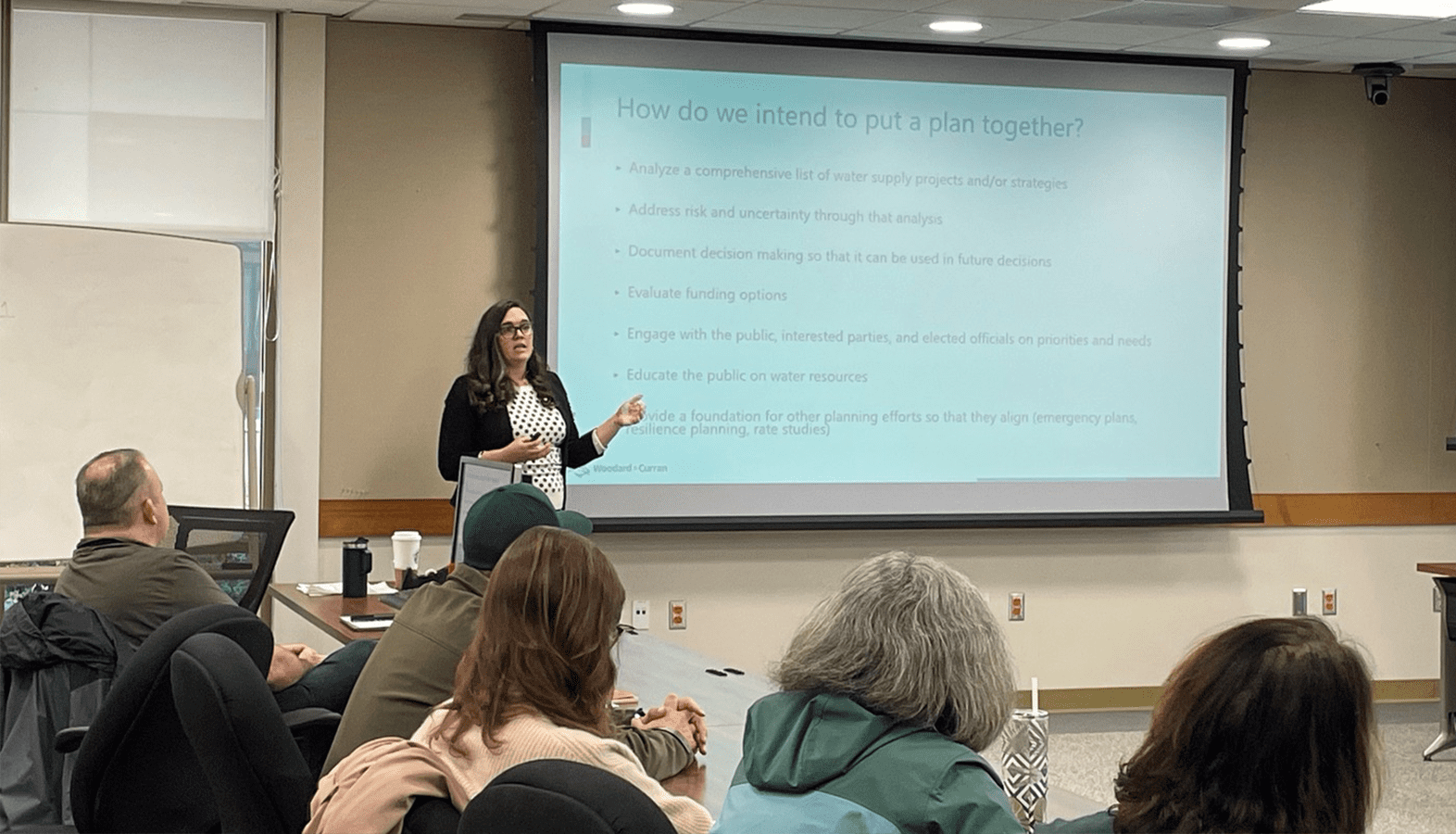
Katie Evans, Woodard & Curran Senior Program Leader, presents at a community engagement event.
These pathways prioritize no regret strategies, such as optimizing existing assets and improving baseline operations, while allowing time to complete the feasibility analyses necessary to justify capital heavy projects in response to emerging future conditions.
Central to this approach was distinguishing between two types of decisions:
- Decisions made during the planning process to select a preferred near term implementation path.
- Decisions deferred to the future that will be informed by clearly defined internal and external triggers, such as regulatory changes, analytical outcomes, or observed shifts in surface water hydrology.
This framework acknowledges a simple truth — not all decisions can, or should, be made today. By explicitly planning for uncertainty, adaptive pathways allow today’s boards and staff to prepare successors with a clear direction, shared understanding, and the flexibility to adjust course without losing momentum.
In the face of an uncertain future, it is encouraging to see that our planning practices can evolve just as effectively as the systems they are meant to support.
